
What Is Dual ADAS Camera Calibration?
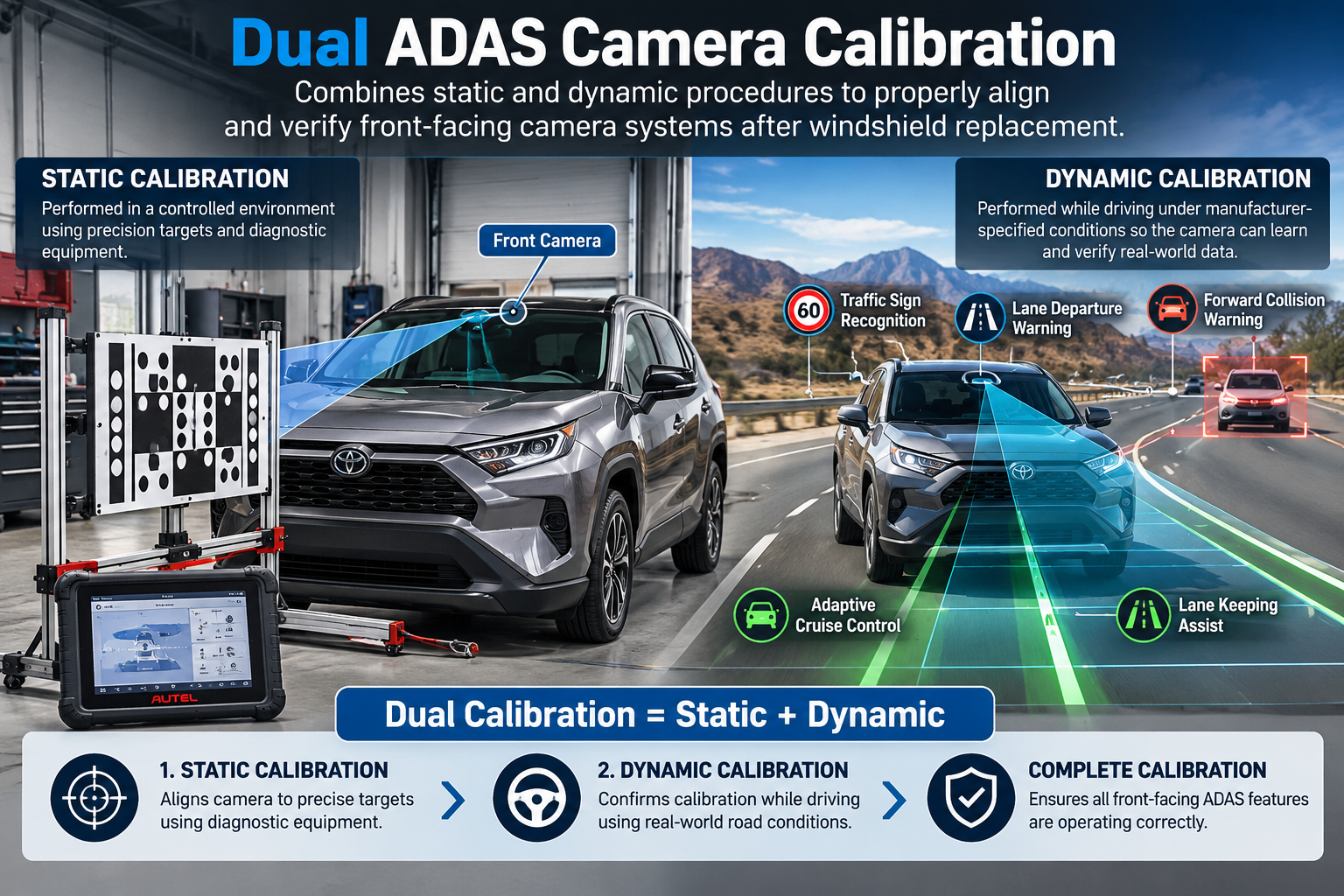
Dual ADAS camera calibration refers to a process in which a vehicle requires both static and dynamic calibration procedures to properly align and verify its forward-facing camera system following windshield replacement.
Static calibration uses precisely positioned targets and specialized diagnostic equipment while the vehicle remains stationary. Dynamic calibration involves driving under manufacturer-specified conditions so the camera can recognize road markings and other environmental reference points.
Dual calibration should not be confused with a dual-camera or multi-camera ADAS system. Some vehicles, including certain Subaru EyeSight-equipped models, have multiple forward-facing cameras with separate calibration requirements. Having multiple cameras does not automatically mean both static and dynamic calibration are necessary.
At 1st Shot Auto Glass, we identify manufacturer-required calibration procedures and coordinate the appropriate service with qualifying windshield replacements throughout Mesa, Phoenix, and surrounding Arizona communities.
Why Does a Dual-Camera System Need Calibration After Windshield Replacement?
The windshield is part of the mounting environment for forward-facing ADAS cameras. When the windshield is removed and replaced, even a small difference in glass position, camera mounting angle, or camera alignment can affect how the system views the road ahead.
Calibration allows the vehicle to establish the correct camera position and viewing reference after installation. This helps the ADAS accurately interpret information such as lane markings, surrounding vehicles, pedestrians, road signs, and other objects detected in front of the vehicle.
A properly completed calibration is particularly important because an ADAS warning light is not always the only indication that a camera’s alignment needs attention. Following the vehicle manufacturer’s calibration requirements after windshield replacement helps ensure the system is operating within its intended specifications.
What Safety Systems Can Depend on the Forward-Facing Cameras?
The forward-facing camera system can provide information used by several driver-assistance features. The exact equipment varies by vehicle, but depending on the application, camera calibration may affect systems including:
- Lane Keeping Assist (LKA) – Helps the vehicle remain centered within its lane.
- Lane Departure Warning (LDW) – Alerts the driver when the vehicle unintentionally begins leaving its lane.
- Adaptive Cruise Control (ACC) – Helps maintain a selected following distance from vehicles ahead.
- Automatic Emergency Braking (AEB) – Can automatically apply braking when the system detects a potential collision.
- Forward Collision Warning (FCW) – Warns the driver of a possible frontal collision.
- Traffic Sign Recognition (TSR) – Uses camera information to identify certain road signs, such as posted speed limits.
- Pedestrian Detection – Helps identify pedestrians in or approaching the vehicle’s path.
Proper calibration is an essential part of a professional windshield replacement whenever the vehicle is equipped with a forward-facing ADAS camera system.
Multiple-Camera ADAS Systems: The Subaru EyeSight Example
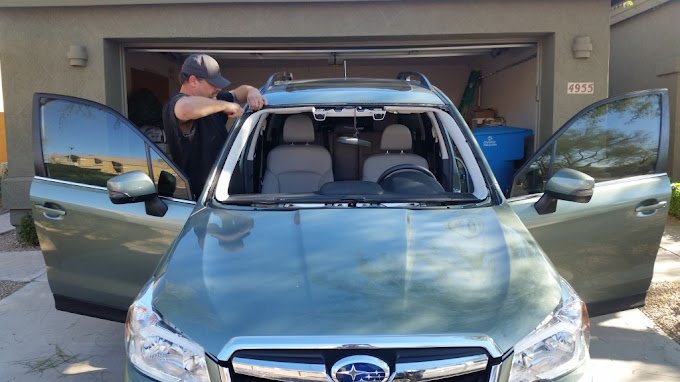
Some modern vehicles have multiple forward-facing cameras that require separate calibration procedures following windshield replacement.
Subaru EyeSight is a good example. The 2024 Subaru Crosstrek uses an EyeSight stereo camera system along with an additional wide-angle mono camera. Subaru’s service guidance specifies separate calibration procedures for these camera systems after windshield replacement.
The wide-angle mono camera uses a specialized calibration target and its own adjustment procedure. Completing the EyeSight stereo camera calibration does not automatically mean the additional camera has been properly calibrated.
Multiple-camera calibration is not necessarily the same as dual static and dynamic calibration. Each required procedure must be identified according to the vehicle’s specific equipment and manufacturer instructions.
At 1st Shot Auto Glass, we coordinate manufacturer-required calibration procedures with qualifying windshield replacements to help ensure all applicable camera systems are properly addressed.
How Dual ADAS Calibration Combines Static and Dynamic Procedures
Not every vehicle uses the same calibration procedure. Depending on the year, make, model, and ADAS equipment, the manufacturer may require a static calibration, dynamic calibration, or both.
Static Camera Calibration
Static calibration is performed while the vehicle remains stationary. Specialized targets, calibration equipment, and precise measurements are used to establish reference points for the forward-facing camera system.
The procedure may require specific conditions such as a level work area, correct tire pressure, proper vehicle loading, adequate space around the vehicle, and carefully positioned calibration targets.
Dynamic Camera Calibration
Dynamic calibration requires the vehicle to be driven under specified road and driving conditions while diagnostic equipment communicates with the ADAS system.
During the procedure, the cameras use real-world information such as lane markings and surrounding traffic to complete the calibration process. Vehicle speed, road conditions, weather, traffic, and visibility can all affect whether a dynamic calibration can be successfully completed.
When Both Static and Dynamic Calibration Are Required
Some manufacturers require both procedures. In those applications, completing only one portion of the calibration does not satisfy the manufacturer’s complete calibration procedure.
This is why the calibration method should be determined by the requirements for the specific vehicle rather than assuming every windshield-mounted camera is calibrated the same way.
Dual ADAS Camera Calibration FAQs
Why does my vehicle need both static and dynamic ADAS calibration?
Some vehicle manufacturers require both static and dynamic calibration to properly align and verify windshield-mounted camera systems after windshield replacement.
Static calibration uses precisely positioned targets while the vehicle remains stationary. Dynamic calibration requires driving under specified conditions so the camera can recognize road markings and other environmental features.
When both procedures are required, completing only one may leave the calibration process incomplete. The exact requirements depend on the vehicle’s make, model, year, and ADAS equipment.
How long does dual ADAS camera calibration take?
Dual ADAS camera calibration generally takes longer than performing either static or dynamic calibration alone because both procedures must be completed.
The total time depends on the vehicle manufacturer’s requirements, calibration equipment, target setup, and road conditions. Some vehicles may require additional diagnostic checks or separate camera adjustments.
Your technician can provide a more accurate time estimate after identifying the vehicle’s specific calibration requirements.
Does dual ADAS calibration mean my vehicle has two cameras?
Not necessarily. Dual ADAS calibration generally refers to a vehicle requiring both static and dynamic calibration procedures. It does not automatically mean the vehicle has two cameras.
Some vehicles, such as Subaru models equipped with EyeSight, use multiple forward-facing cameras that may require separate adjustments or calibration procedures.
The number of cameras and the type of calibration required are two different considerations. Technicians must follow the manufacturer’s procedures for the vehicle’s specific camera system.
Does insurance cover dual ADAS calibration after windshield replacement?
Many comprehensive auto insurance policies cover manufacturer-required static and dynamic ADAS calibration when necessary as part of a covered windshield replacement.
Coverage depends on the policy, vehicle, and claim details. Some vehicles may also require additional camera calibration procedures that must be documented separately.
At 1st Shot Auto Glass, we assist Arizona customers with their insurance claims and coordinate required ADAS calibration following qualifying windshield replacements.
Can dual ADAS calibration be completed the same day as windshield replacement?
Yes, dual ADAS calibration can often be completed the same day as windshield replacement, depending on the vehicle’s requirements, equipment availability, and driving conditions.
The windshield adhesive must first reach the manufacturer’s specified minimum safe drive-away time before any road-based calibration begins. Static calibration also requires suitable equipment and a properly prepared calibration area.
At 1st Shot Auto Glass, we coordinate required ADAS calibration with qualifying windshield replacements throughout Mesa, Phoenix, and surrounding communities. Scheduling depends on the specific vehicle and calibration procedures.
Windshield Replacement With Dual ADAS Calibration in Mesa & Phoenix, AZ
Does your vehicle require both static and dynamic ADAS calibration after windshield replacement? 1st Shot Auto Glass provides professional mobile windshield replacement throughout Mesa, Phoenix, and surrounding Arizona communities.
We identify manufacturer-required calibration procedures, coordinate the appropriate services, and assist with qualifying insurance claims to make the replacement process as convenient as possible.
Get Up To $450 Cash Back With a Qualifying Insurance-Approved Windshield Replacement
Eligibility and available cash-back amounts vary by vehicle, insurance coverage, windshield features, and claim approval.
Call (480) 233-9368 or Text
Free Mobile Service • Family Owned & Operated